
AI solution didn’t just change what software can do. In fact, it changed who builds it.
Who builds the AI solution now?
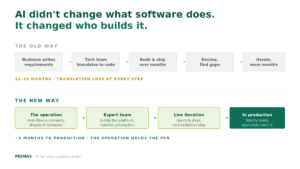
For two decades, enterprise software was built one way. First, the business wrote requirements. Then, a technical team translated them into code. As a result, months passed, gaps appeared, more months passed.
That translation step – from what the operation knows to what the software does – was unavoidable. It was also where most of the cost, the delay, and the lost fidelity lived. Eventually, he translation was the cost of doing business.
However, a modern AI solution removes that painful step for a meaningful class of business challenges. Therefore, building an AI solution isn’t mostly a coding project anymore – it’s a configuration project. Because of that, the people best equipped to design these systems are no longer the programmers, but the people who actually run the business operation.
That single shift changes who holds the pen.
What it looks like on the ground
We’ve been deploying AI-powered quality assurance inside a contact center running more than 1,000 agents. Like most operations, they could manually review only about 1% of calls. The other 99% were invisible.
The first conversation didn’t start with a 20-page requirements document. It started with a working session: a Primas engineer, the QA lead, and an operations manager looking at real calls together with the AI’s output projected live. The team reacted in real time – that flag is wrong, that one matters more, that scenario needs different handling. Within days, a working scoring approach existed, shaped by the operation’s own judgment instead of an engineer’s interpretation of a spec.
AI changes who controls the solution.
When the operation shapes the AI directly, three things change.
Iteration collapses. Cycles that used to take weeks of requirements-to-code-to-review now take hours of expert-to-AI-to-validation. Same afternoon, not next quarter.
Fidelity holds. The AI’s behavior reflects what the domain experts actually know – not what an engineer interpreted from a document. The translation loss disappears.
The expert team’s job shifts. From building the behavior to building the platform that holds the behavior. Integration, scale, and reliability stay hard, and they stay with the engineers. Encoding domain knowledge does not – that moves to the people who own it.
The part that proves AI solution change it
To test this accuracy early on, QA leadership audited 42 AI-scored calls against their own human judgment. On roughly a third, however, the AI didn’t match.
But here is the catch: that gap wasn’t a model failure. It was a context failure. Hence the AI simply didn’t know the operation well enough yet.
So the operation’s subject-matter experts and trainers sat down and encoded what they knew – scoring rubrics, scenario libraries, edge-case handling, escalation criteria – as the knowledge base that grounds the AI. After calibration, the AI’s scoring matched the human auditors on the same 42-call benchmark.
A vendor cannot encode your operation’s knowledge as well as your operation can. The build only works when the operation holds the pen.
Why the timeline compresses
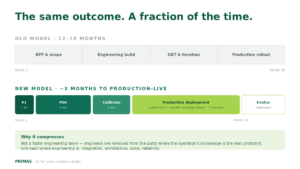
In fact, The same operational outcome that would have taken 12 to 18 months the old way reaches production in about three. This speed doesn’t come from engineering teams simply working faster. Instead, it comes from putting the right people in the right roles.
Engineers stop handling operational logic. Rather, they focus entirely on what they do best: architecture, scale, and reliability. By removing them from the business side of the build, every phase matches the exact expertise it needs.
Where this AI solution leads next
Owning the AI’s behavior is just the first step. Crucially, you must also own the software around it. This means controlling the reports, dashboards, and alerting rules that match how your specific business runs.
This is no longer a technical bottleneck. New AI-assisted tools like Claude Code and Lovable make building these tools easy. For instance, a QA director can now build a working dashboard in one day, while an operations manager can instantly set up alerting rules for the floor. As a result, this represents a massive shift from the past. In the old model, this work required outside vendors. You had to file tickets and wait on a road-map you couldn’t control. Today, however, that delay is completely gone.
For contact-center leaders, the question has changed. It is no longer whether to use AI. It is who holds the pen while it gets built. Early adopters will spend the next decade configuring their own AI. Meanwhile, their competitors will still be filing tickets. That gap eventually compounds over time.
Want to see it on your own calls – not a demo deck?
Send us five of your own call recordings (anonymized to remove PII – we’ll guide you through it). We’ll run AI quality assurance across all five and walk you through exactly what it catches in a 30-minute session. You’ll see how it scores against your criteria and what surfaces in the calls no one had time to review. No procurement process, no pressure – if it’s useful, great; if not, you keep the analysis.
👉 Head over to our Primas Contact Page, drop us a line, and we’ll handle the rest.