AI Quality Assurance · regulated BPOs

Scoring a call with AI is easy.
Trust is the product.

A 95%-accurate score no QA manager dares tie to a KPI is worthless. So we don't sell the model — we build the operating system around it: confidence is visible, every override teaches the rubric, and you own the loop. On your stack. Your data never leaves.

Book a 30-minute strategy session

100% call coverage · your rubric · on-prem capable

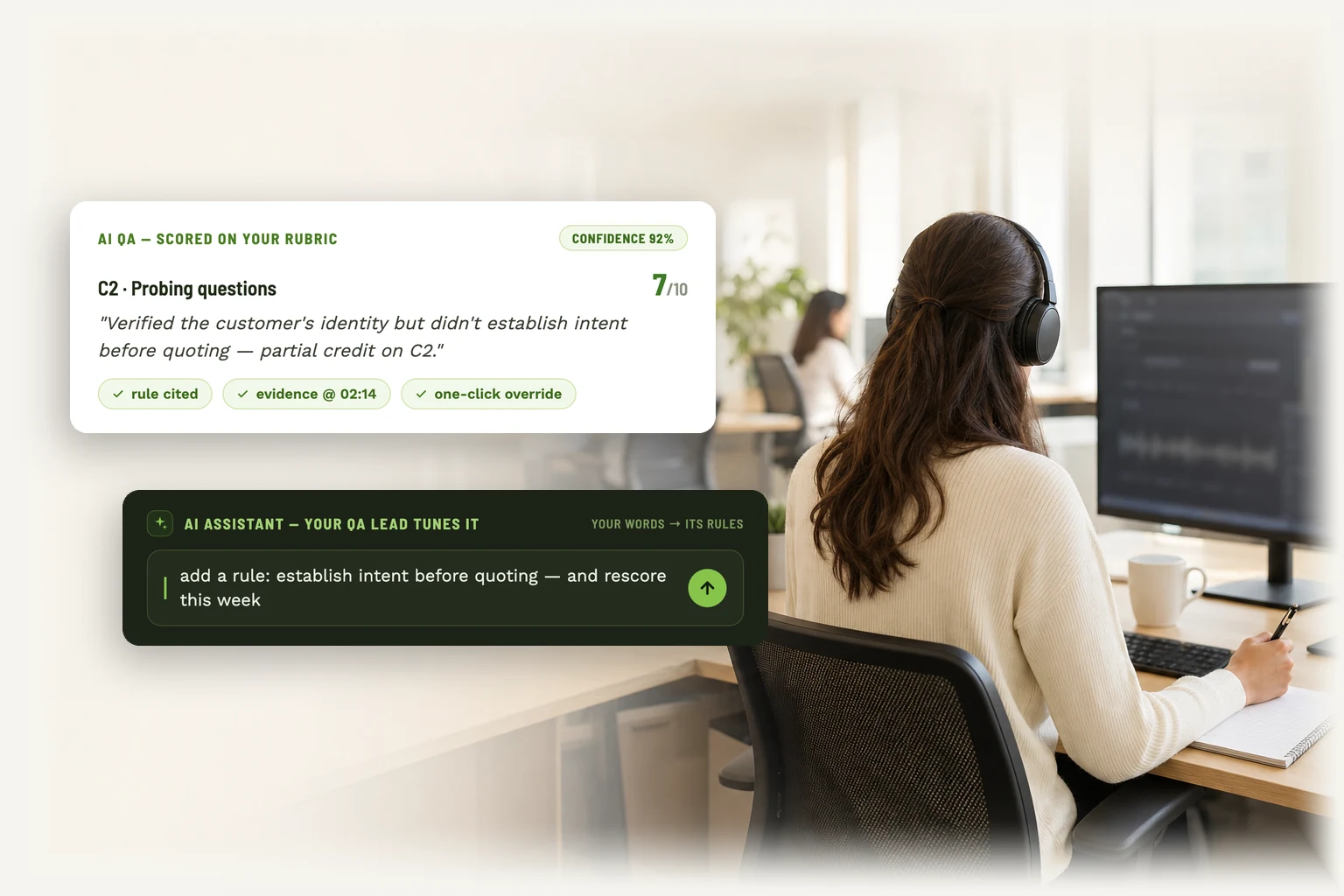
AI QA · scored on your rubricConfidence 92%
C2 · Probing Questions7/10
"Agent verified the customer's identity but didn't establish the reason for the call before quoting — partial credit on C2."
▦ Rule cited: establish intent before quoting · evidence @ 02:14

A score you can defend — the reasoning, the rule it cites, and the evidence line. One click to override.

Trusted by leading enterprises across the globe

Visa UW Medicine Blue Cross Blue Shield HGS Aflac Decathlon ISB ZaloPay

The QA director's dilemma

Every option asks you to give something up.

Manual sampling, locked-in suites, or black-box AI you can't defend. Each one fails somewhere in the chain from the QA manager to the brand client.

The 5% problem

Manual sampling misses 95%.

Brand-damaging moments and compliance failures hide in the unscored 95%. Risk compounds weekly.

Suite lock-in

Buy the whole CCaaS stack to get AI QA.

The big suites bundle WFM you already pay for and tie you to a multi-year contract just to score calls.

Black-box scoring

A number your QA manager can't defend.

AI-natives market "100% accuracy" but won't show how a score was reached. She can't defend what she can't explain.

No feedback loop

It scores, then stops.

There's no path for your senior auditor's override to improve the system. Drift sets in within 90 days.

The Primas answer

You shouldn't have to give up any of them.

One system answers all four — no trade-off. Here's the map; the rest of this page is the proof.

Manual sampling misses 95%100% of every call, scored
Buy the whole suite to get QAYou own the rubric & the loop
A score you can't defendConfidence visible on every criterion
It scores, then stopsEvery override sharpens the rubric
The proof starts with trust · a score you can defend

We tell you where the AI is sure — and where it isn't.

Every call is scored with a confidence number per criterion. The system auto-confirms what it's sure of and routes only the uncertain calls to a human. No black-box "100% accuracy" claim.

~70%
~20%
8%
2%
High · ≥85%
~70%
Auto-confirmed
Medium · 60–85%
~20%
Quick supervisor review
Low · 35–60%
~8%
Flagged for full review
Very low · <35%
~2%
Senior auditor only

The Primas QA Suite

One platform — capture, score, calibrate. Across 100% of your calls.

One operating system: record every call, score it against your rubric, analyse it — and feed every override back into a sharper rubric.

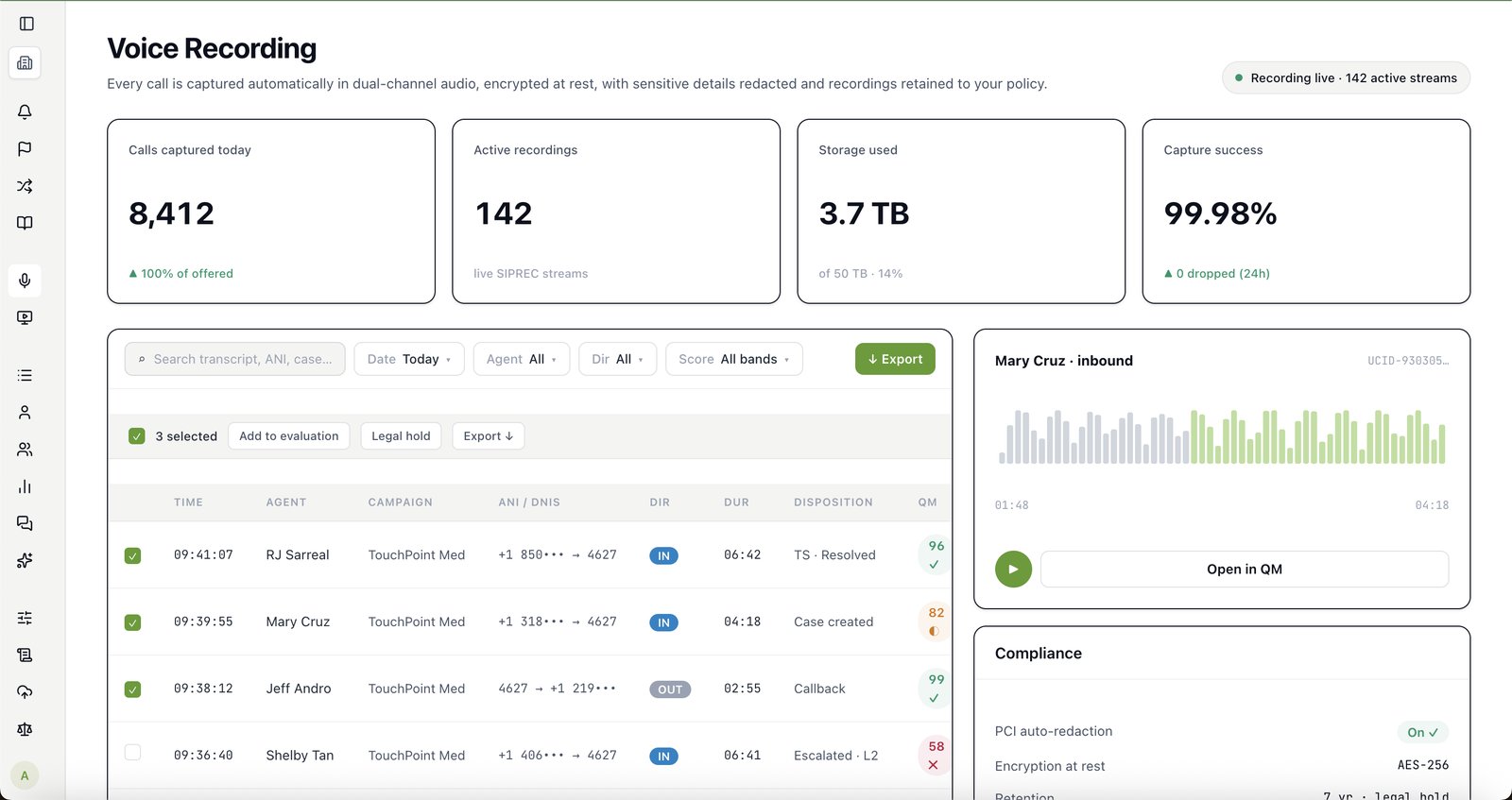
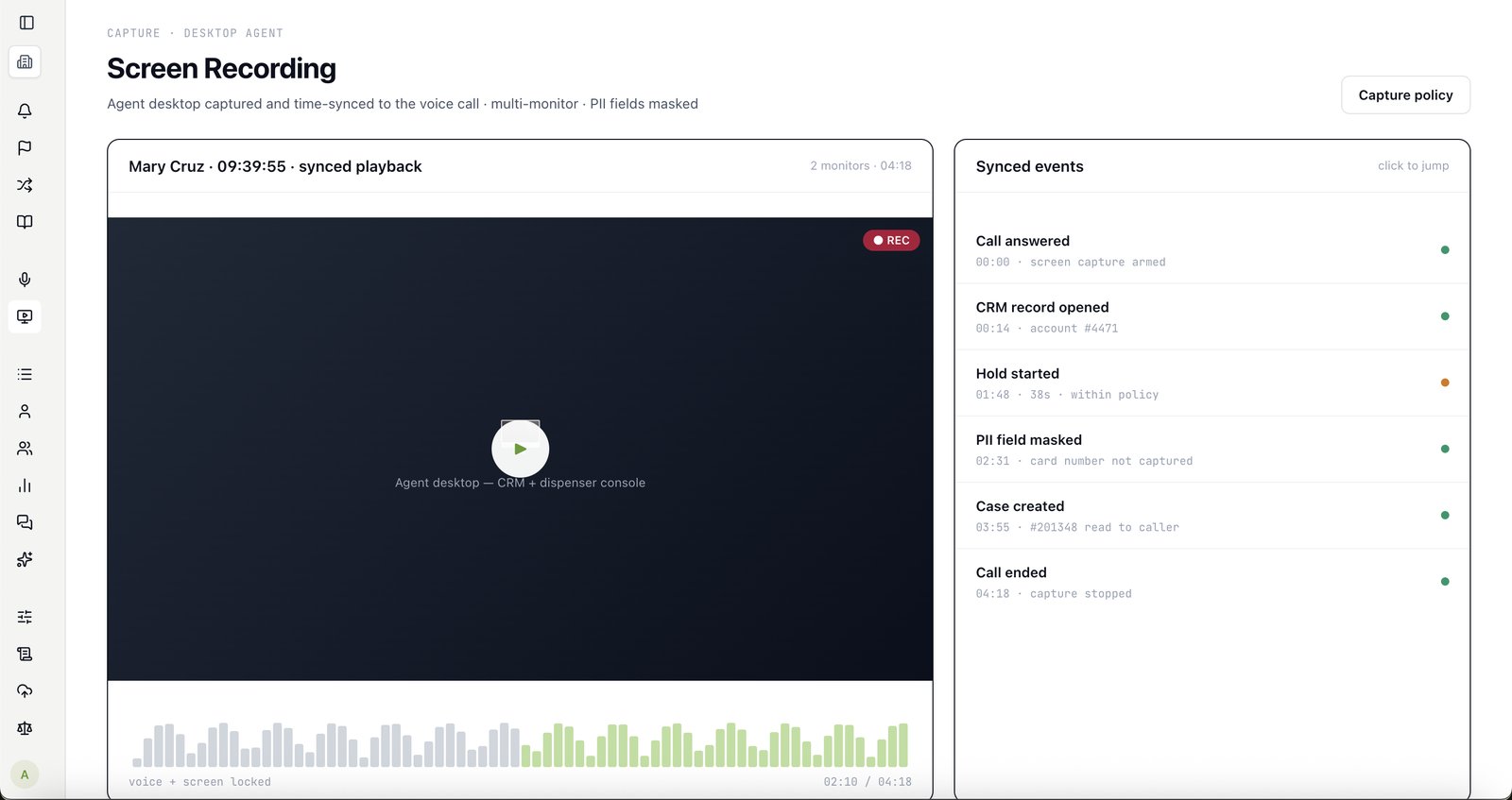
Every call recorded automatically — voice and the agent's screen, time-synced, encrypted (AES-256), PCI auto-redacted, and transcribed speaker-by-speaker. Nothing falls through a sampling gap.

Voice Recording
Voice Recording — 100% capture, dual-channel, encrypted, PCI auto-redact
Screen Recording
Screen Recording — agent desktop, synced to the call timeline

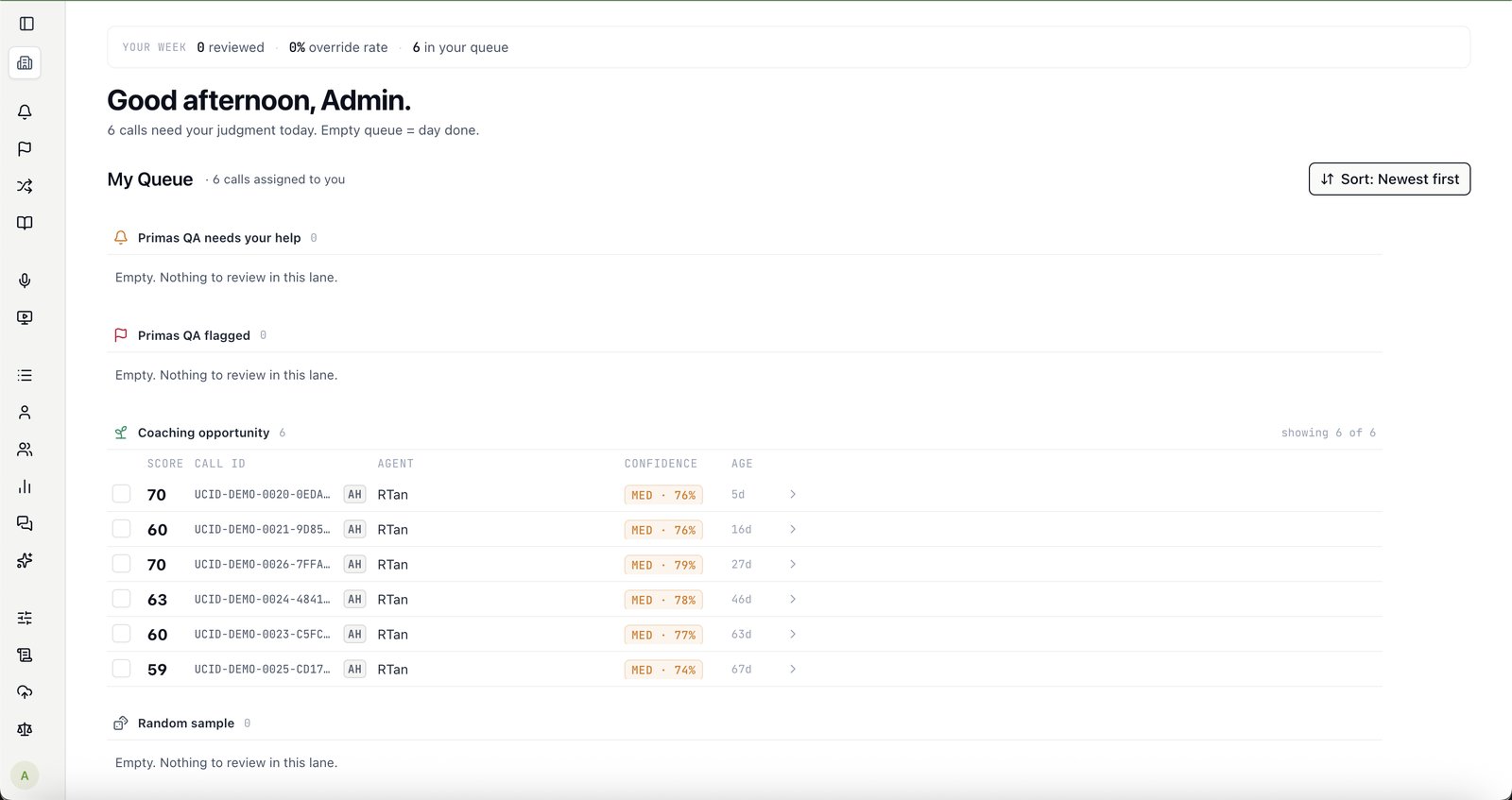
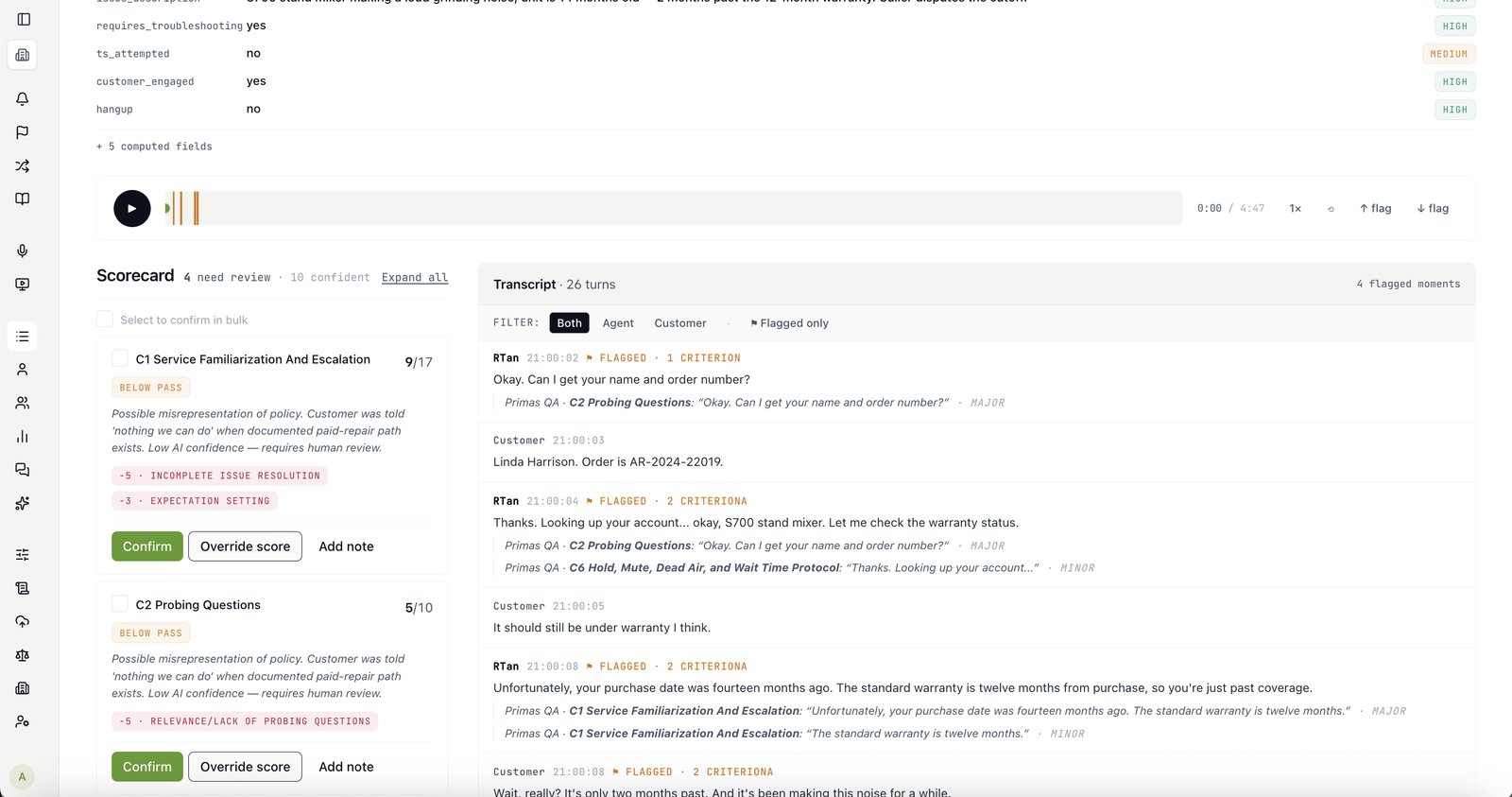
Every call scored against your rubric and routed by confidence — the inbox sorts by what the AI is uncertain about, not by call ID. Each criterion shows its reasoning, the rule it cites, and the evidence line. One click to override; the override teaches the rubric.

Triage inbox
Triage inbox — calls routed by AI confidence; review only what needs a human
Defensible scorecard
Defensible scorecard — each criterion with its reasoning, cited rule and evidence

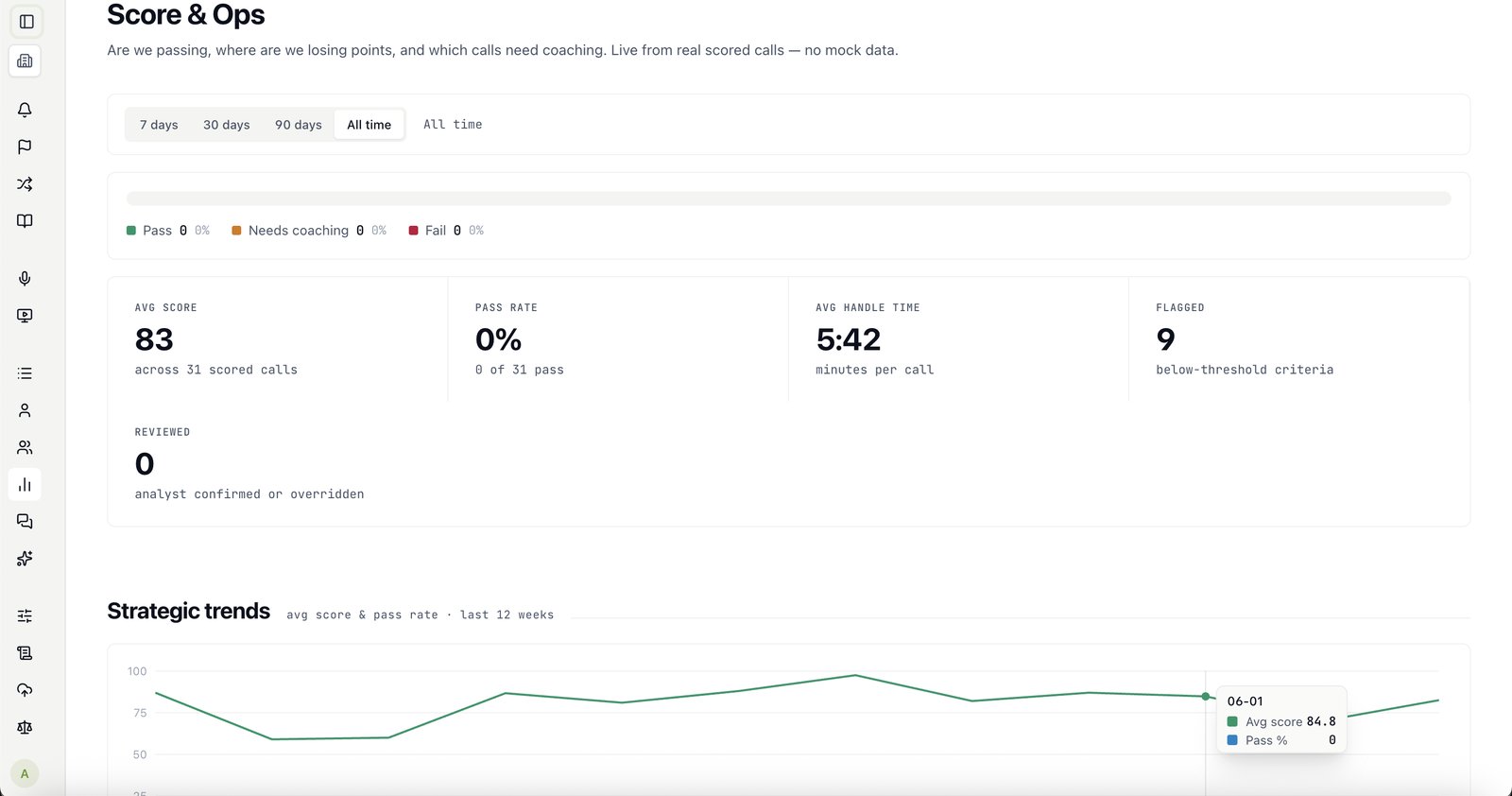
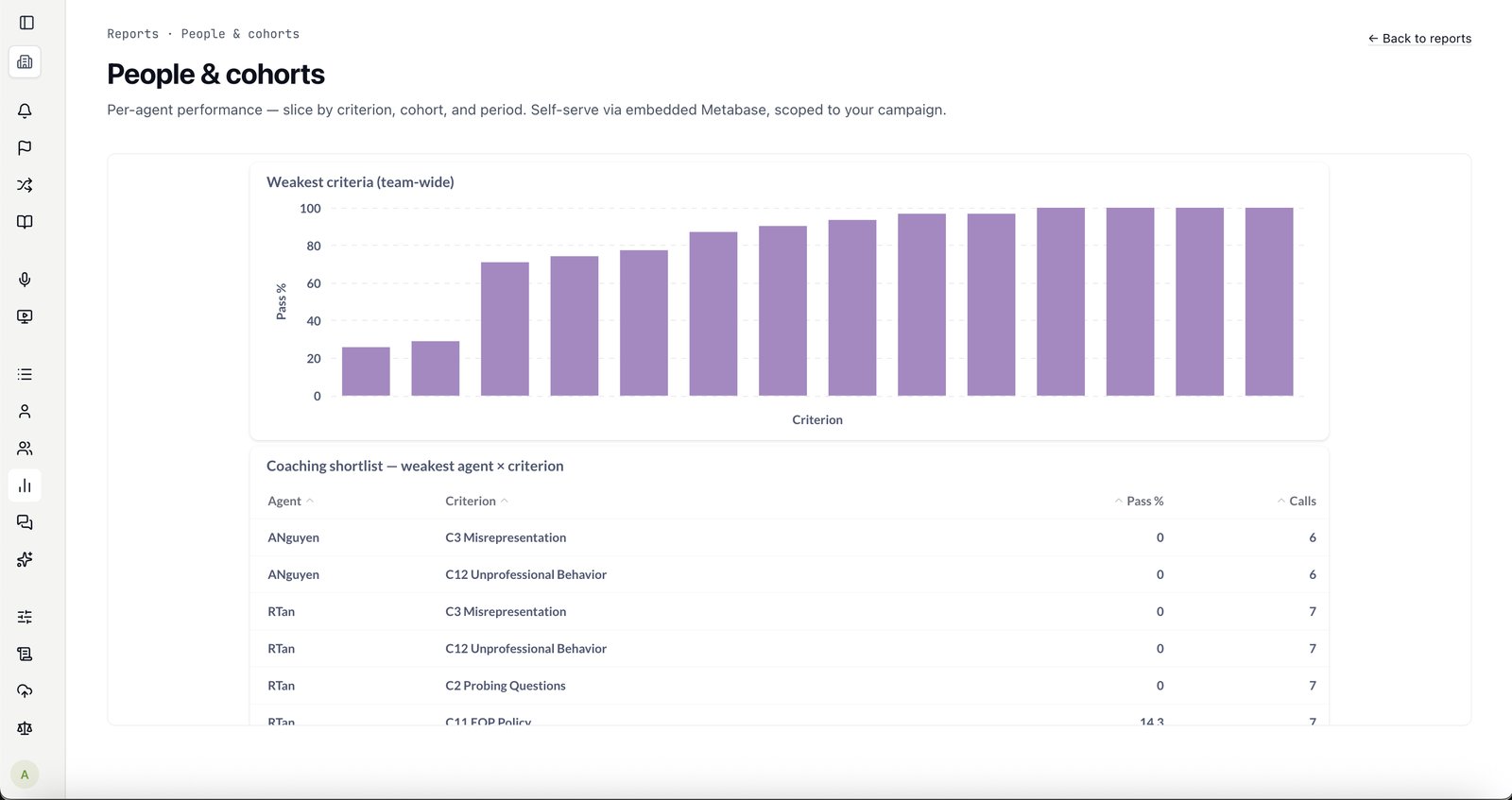
Quality and operational KPIs on every interaction, not a 5% sample — score distributions, pass rates, agent and cohort performance, and a builder for the cuts your team runs on.

Score and Ops
Score & Ops — average score, pass rate and 12-week trends
People and cohorts
People & cohorts — agent and team performance
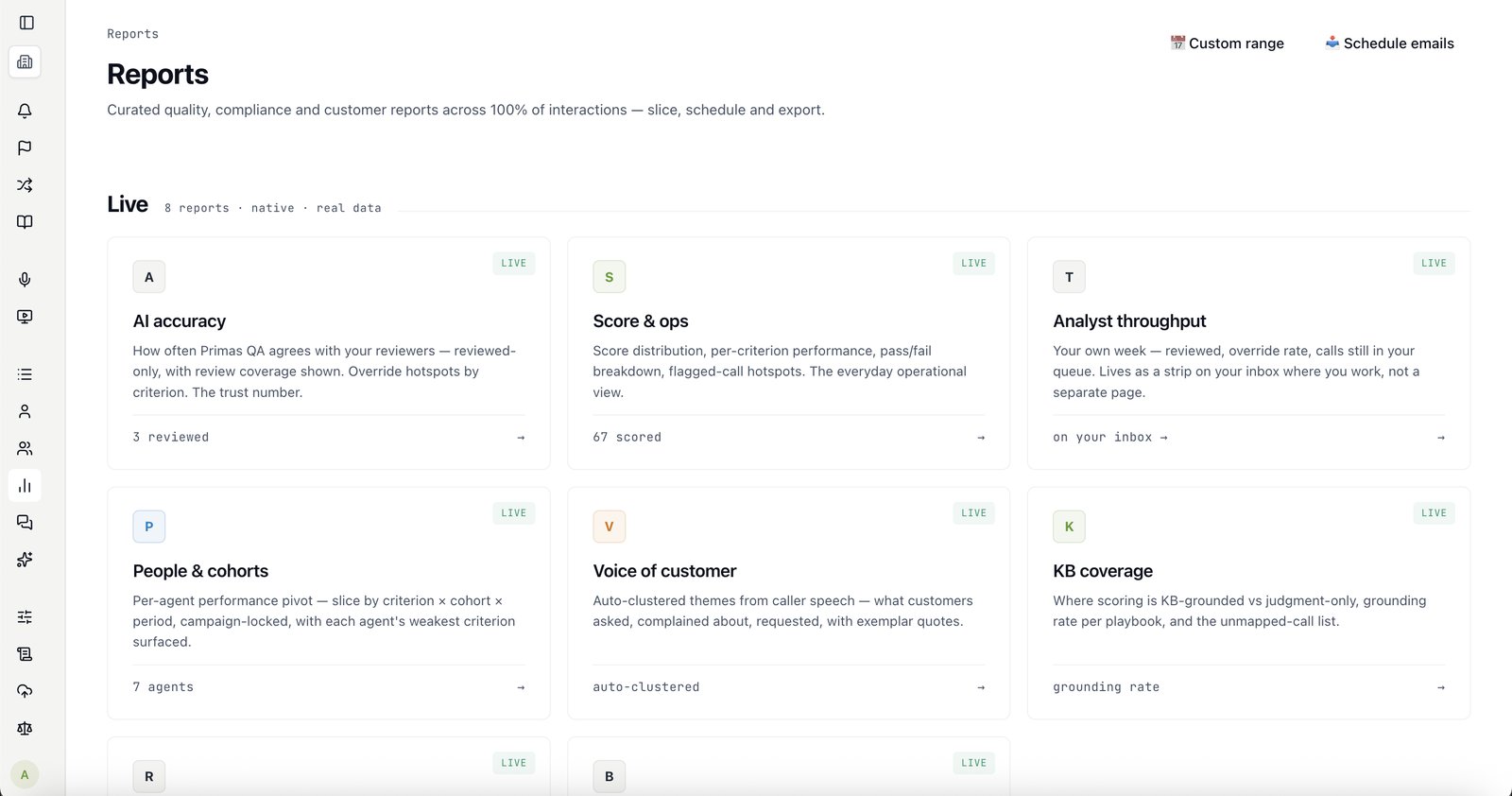
Reports
Reports — operational & quality cuts, exportable to your BI

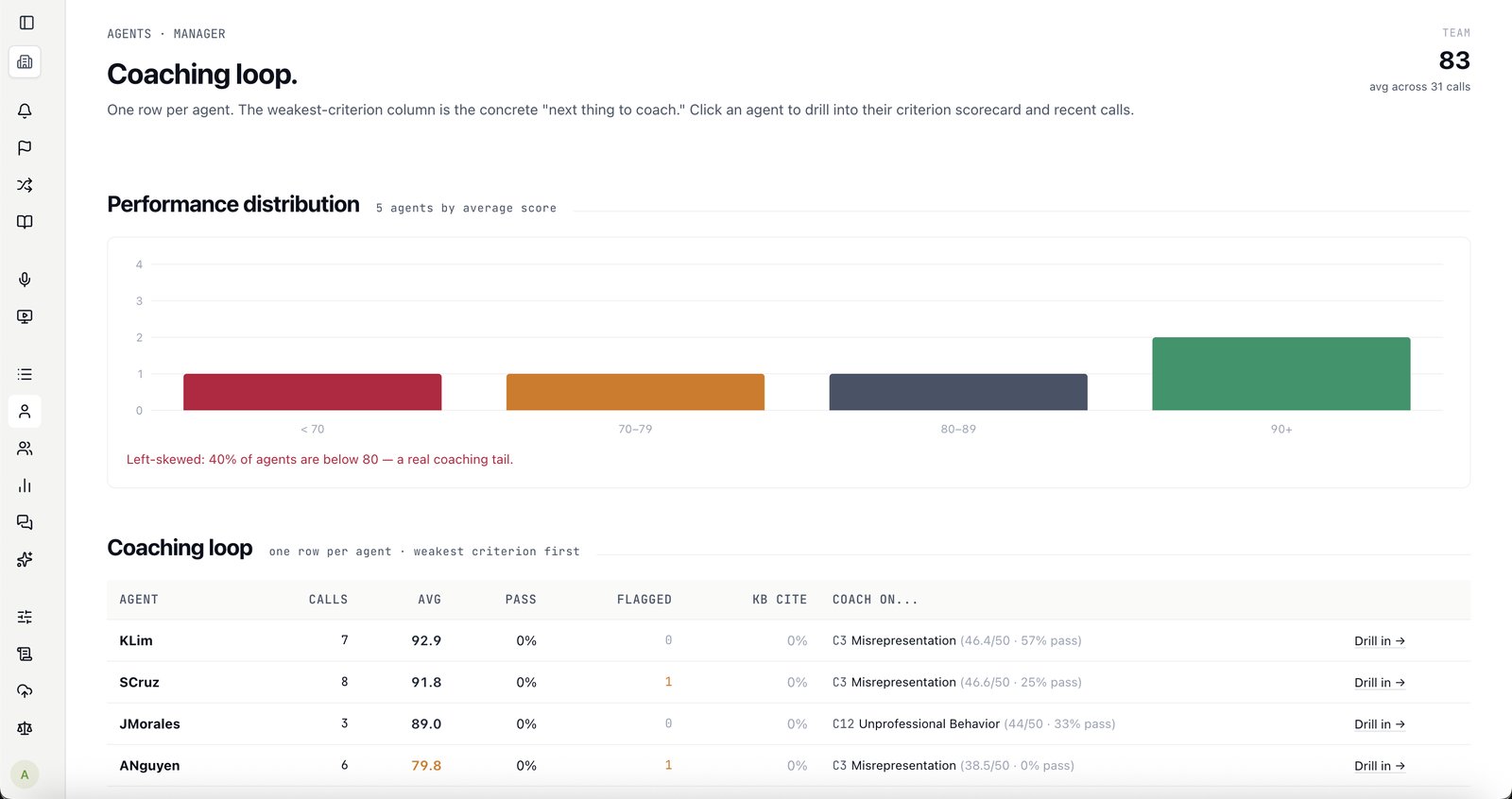
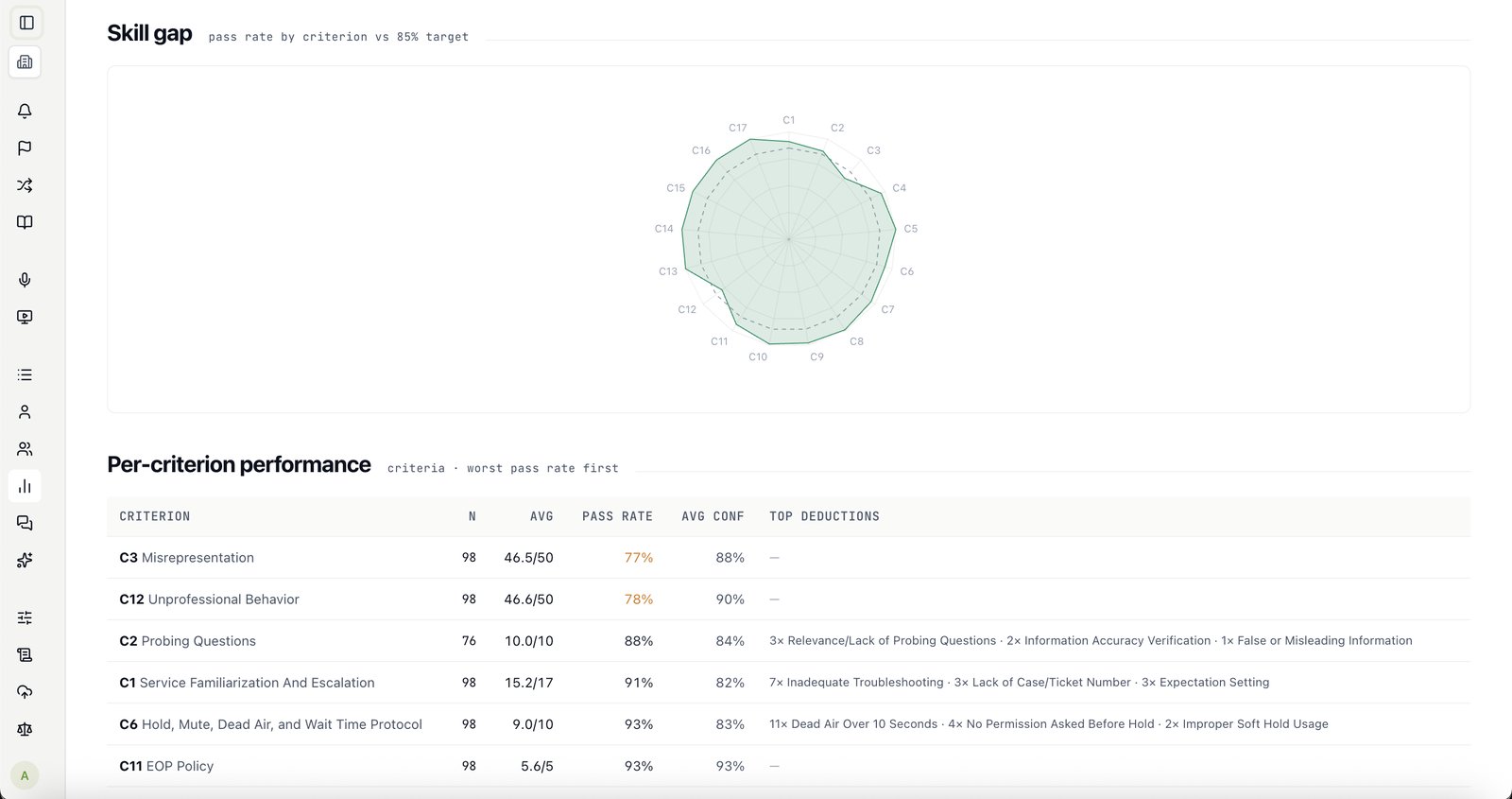
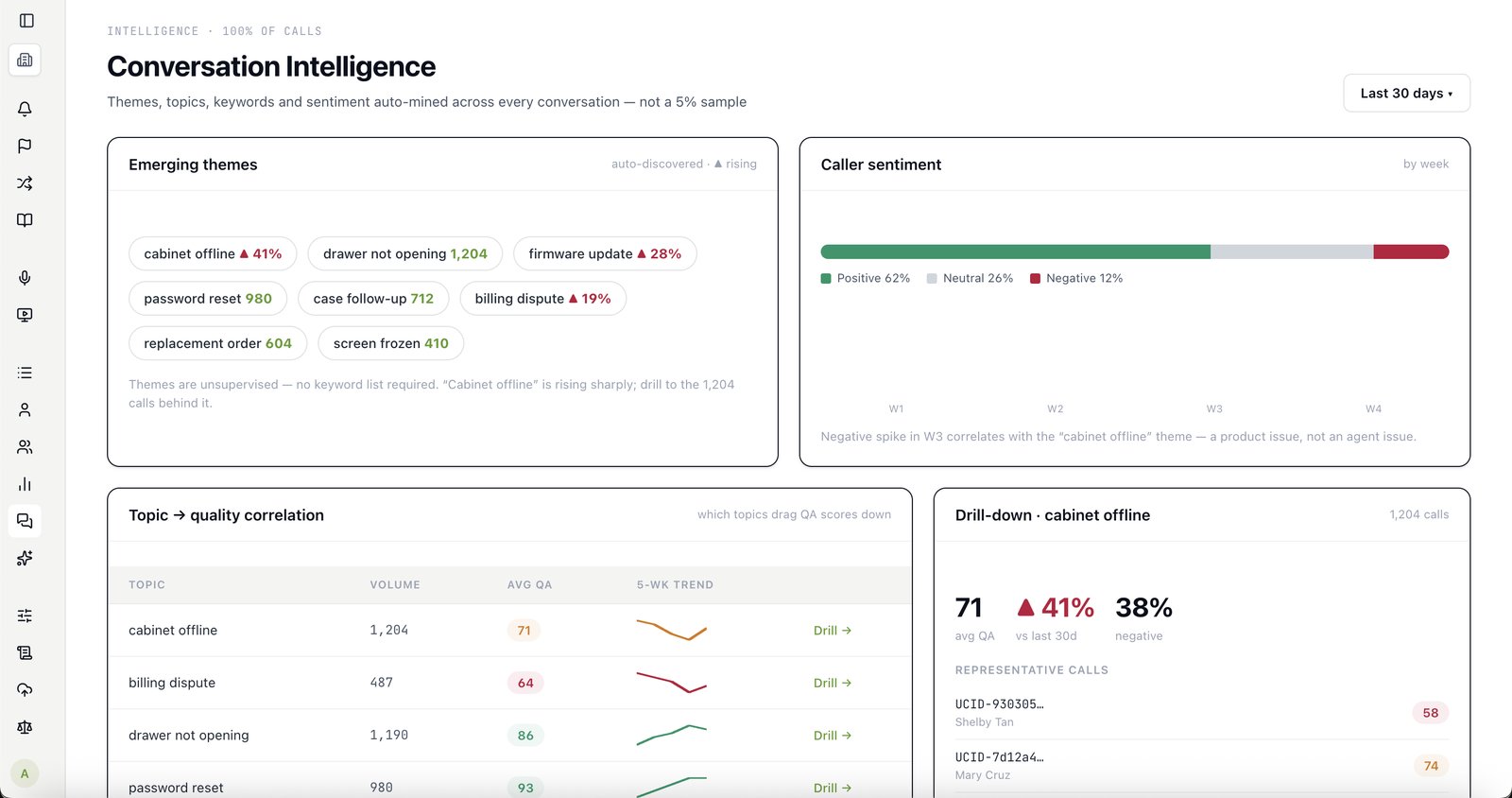
Turn scores into coaching and insight — each agent's weakest criterion with example calls, plus auto-discovered themes, sentiment trends, and which topics drag QA scores down.

Coaching loop
Coaching loop — performance distribution and per-agent coaching
Per-criterion performance
Per-criterion performance — which criteria drive deductions, ranked
Conversation Intelligence
Conversation Intelligence — themes, sentiment, topic → quality

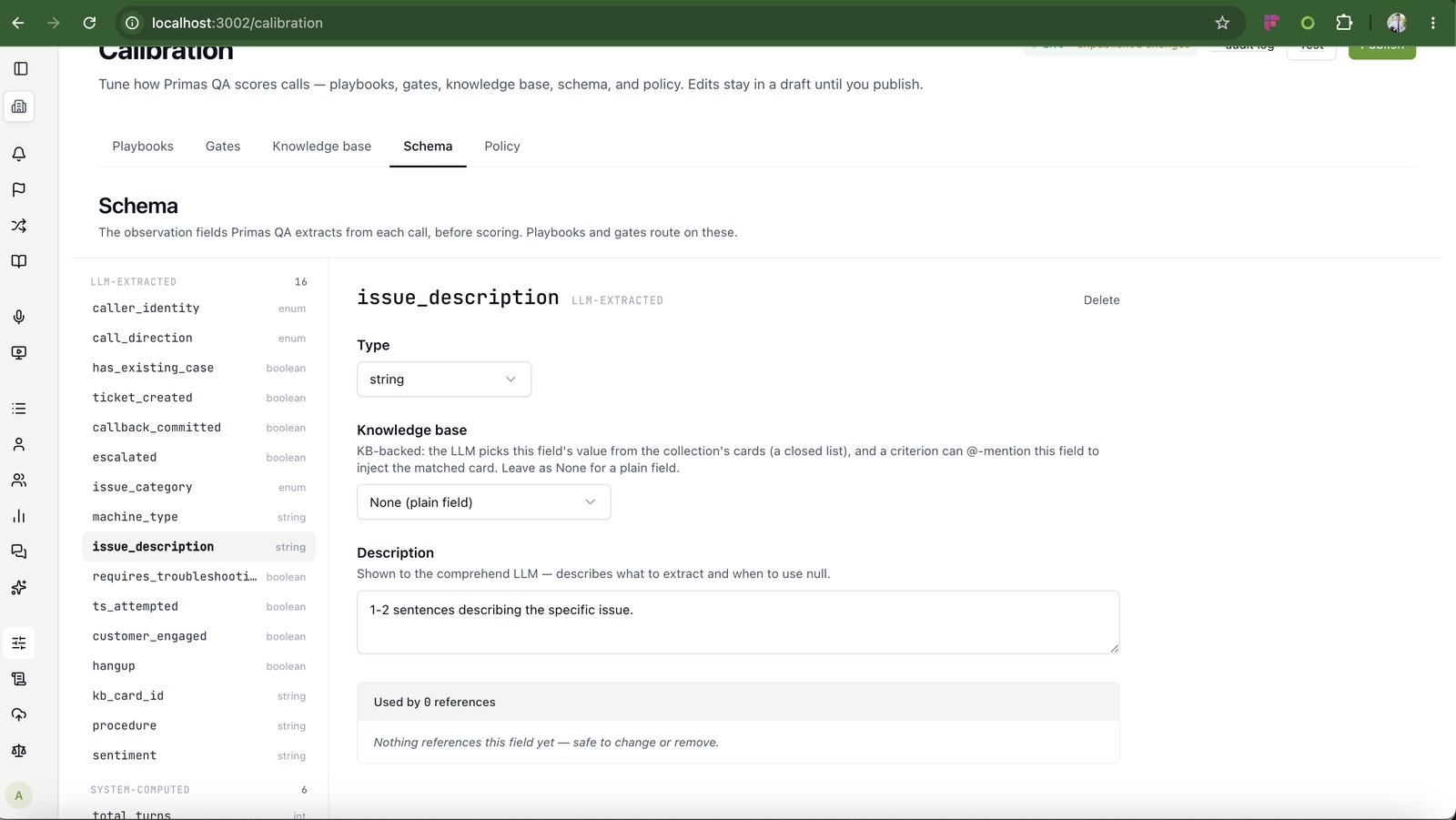
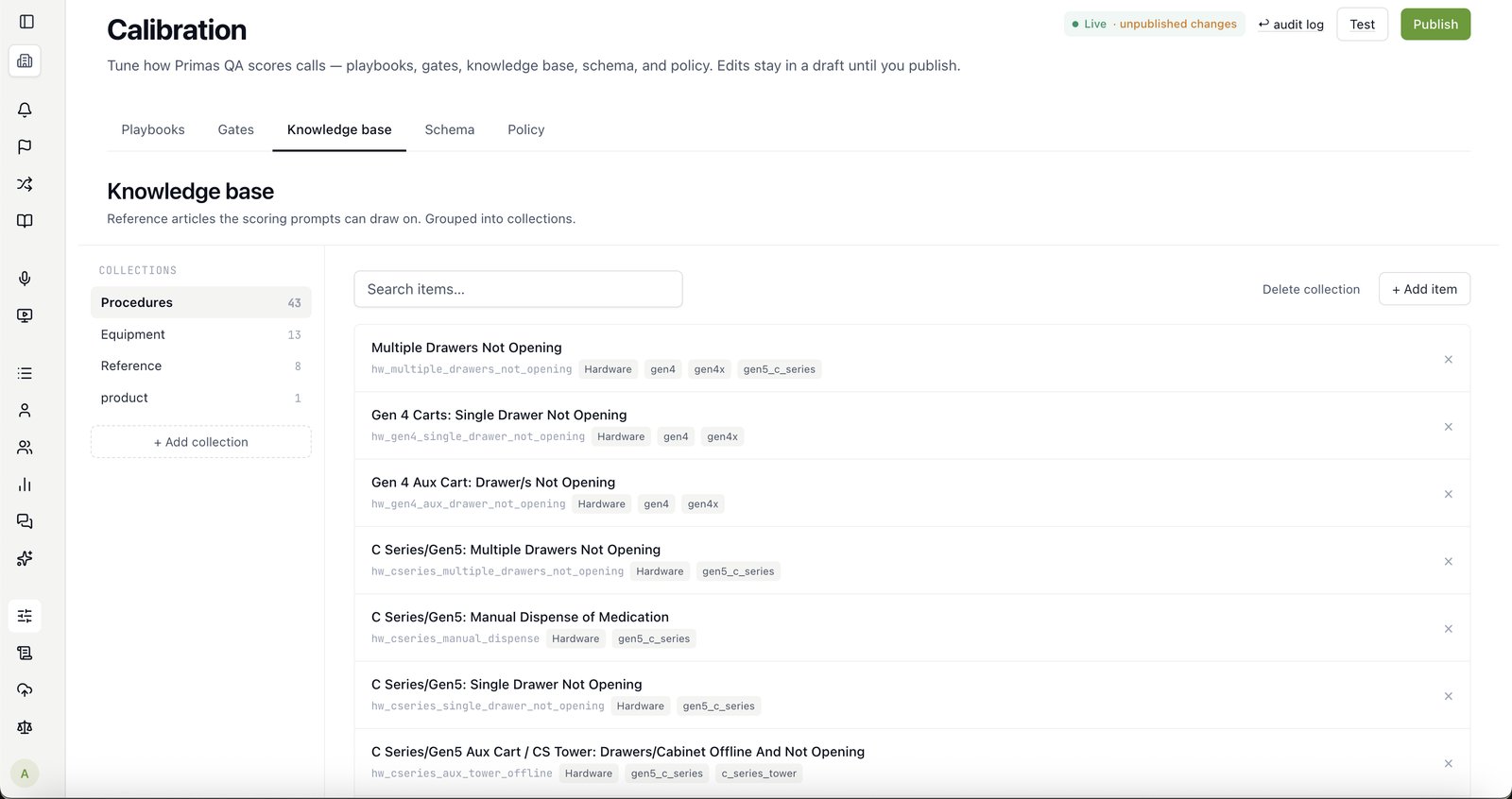
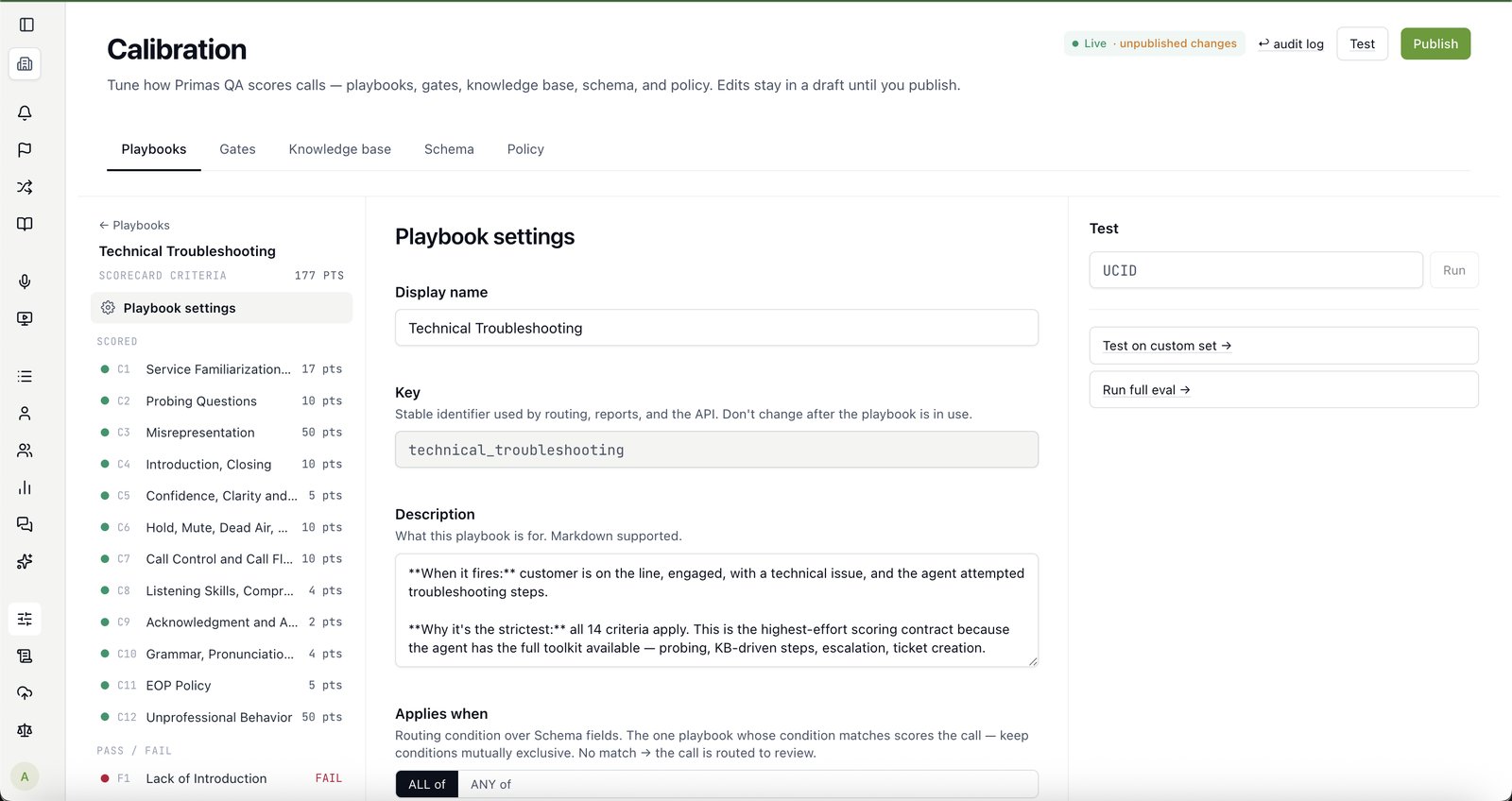
Your team owns the rubric and the knowledge base and edits them in-app. Every change runs against an audit set and must clear an eval-gate before it publishes — versioned, with rollback.

Rubric editor
Rubric & criteria editor — your scoring logic, in your hands
Knowledge base
Knowledge base — the policy answers scoring is grounded in
Playbook settings
Playbook settings — per-campaign configuration

Continuous calibration

A closed loop that sharpens your scoring every quarter.

High-confidence calls auto-confirm and flow to coaching and reporting. Low-confidence calls — plus a 10% quality sample of the confident ones — route to human review, where overrides aggregate into rubric and knowledge-base improvements. Each change passes an eval-gate before it redeploys. Most AI QA tools score and stop; Primas calibrates.

THE LEARNING LOOP Call in Clean & score Scored against your rubric Confidence Routed by confidence Auto-confirm High confidence · ~70% Ops & coaching Coaching · Flagged-call review · Reporting high Low confidence · ~30% 10% quality sample Human review Edit scores, add notes AI aggregates signals Generates suggestions Director updates rules Rubric & knowledge base Test → Publish Eval-gate ≥85%, versioned Calibrated rules redeploy to scoring

Before we begin

The first question isn't "are you ready to buy?" It's "is this campaign worth the change?"

A retail post-purchase line probably isn't. A regulated medical, financial or legal-intake campaign almost certainly is — where a brand client will pay a premium for the attestation we generate at quarter's end.

30 days

To first scored batch

From signed SOW to live scoring with confidence routing.

≥85%

Eval-gate, or we iterate free

If auditor-AI agreement isn't there by day 30, calibration continues at no cost. Implementation is milestone-paid, not on signature.

Q

The Brand Quarterly Report

The attestation a regulated brand client can show their regulator — the artifact that earns the change.

On your stack · no lock-in · compliant

You pick the AI models — and where your data lives.

Recordings, scores and PII stay inside your environment. Plug into the telephony you already run; choose the AI provider that fits each criterion — your accounts, your choice.

Works with your telephony

Plugs into your existing platform — no rip-and-replace.

Avaya Cisco Genesys Asterisk Vicidial

Model-agnostic, per criterion

Pick the right AI for each scoring dimension; swap as the landscape shifts.

LLMOpenAIGeminiClaudePrimas
STTDeepgramElevenLabsPrimas

Compliant & on-prem

All data stays inside your environment — PII never leaves your hardware.

HIPAA certified FedRAMP certified StateRAMP authorized

Proven on real contact centers

Built by integrators, not a startup chasing the hype.

Two published case studies — regulated, high-stakes, on infrastructure they already ran.

Government · public sector

A FedRAMP & StateRAMP voicebot — live in 2 months.

For a US government department: a secure voicebot on Azure Gov, full compliance delivered in a two-month timeline.

Read the case study →

Healthcare

AI on an existing Avaya contact center — HIPAA-certified.

For a nationwide US medical center: Primas CX Suite on their existing Avaya infrastructure. HIPAA-certified, 75% faster delivery, 20% lower TCO.

Read the case study →

Is this for you?

We know our lane — and we'll tell you straight.

Primas QA is for you if…

  • You run regulated campaigns — medical, financial, legal-intake
  • A brand client's renewal rides on the QA you can defend
  • Data can't leave your environment
  • You want to own the rubric and the calibration loop, not rent a black box

Probably not, if…

  • A 5% manual sample is genuinely enough for your risk
  • Your campaign isn't heavy enough to be worth the organizational change
  • You just want a score, not a system you can defend

Questions

What QA directors ask us first

Do you claim 100% accuracy?

No — and that's the point. We give every score a confidence number and tell you exactly where the AI is sure and where it isn't. High-confidence calls auto-confirm; the uncertain ones go to a human. An honest system you can defend beats a "100% accurate" black box you can't.

Is it scored against my rubric, or yours?

Yours. Professional Services calibrate it on your real calls and your criteria, then hand the rubric to your team — you own it and edit it in-app.

How does an override actually improve the system?

Every override and supervisor note is captured as a signal. Signals aggregate into recommendations with the originating calls cited; your rubric team applies or dismisses each, drafts run against an audit set, and only changes that hit ≥85% auditor-AI agreement publish — versioned, with rollback.

Does my call data leave my environment?

No. Recordings, scores, transcripts and the audit trail stay on your infrastructure. PII never leaves your hardware. No SaaS sits in the middle of your customer data.

Does it run on my existing Avaya, Cisco, Genesys or Vicidial?

Yes — it plugs into your existing telephony; your recordings stay where they are. No rip-and-replace.

How fast can we go live?

~30 days from signed SOW to a live scored batch with confidence routing. Implementation is milestone-paid against acceptance criteria — not on signature.

See defensible AI QA on your own calls.
A 30-minute strategy session, no obligation. We'll look at one of your regulated campaigns and whether the playbook fits.

Book your session

Talk To Our Experts

Schedule your free, personalised demo at a date and time that works for you